
Quick Summary: Poor posture usually means the head drifts forward and the shoulders round after long hours at a screen or behind the wheel. Research shows no single posture causes or prevents pain, but holding any position too long can leave the neck and upper back sore and stiff. Dr. Hansen looks at how you move and what your days look like, not just how you stand.

Poor posture usually means the head sits forward of the shoulders, the shoulders round, and the upper back curls, often after hours at a laptop, a phone or a steering wheel. Forward head posture is the name for that head-forward position. Many people notice it in a photo first, then connect it to a stiff neck or an ache between the shoulder blades by the end of the day.
Common complaints that bring people in:
Everyday habits add up too: carrying a bag or a child on the same side every day, a car seat reclined so far that your head juts forward, or a tall stack of pillows that props your neck up all night. Screens are a big part of the picture. Looking down at a phone or laptop for hours pulls the head forward and keeps the neck muscles working the whole time. MedlinePlus on neck pain lists bending over a desk for long stretches and a monitor set too high or too low among the everyday causes of neck strain.
A quick side photo can show whether your ears sit in front of your shoulders. It’s a starting point, not a diagnosis, and plenty of people with a forward head have no pain at all.
We see this pattern constantly in our College Station office, especially in Texas A&M faculty, graduate students and anyone whose job lives on a laptop, including plenty of people working from home in neighborhoods like Castlerock.
Research has not found that one “bad” posture causes pain or that one “good” posture prevents it. Researchers at Curtin University, writing in The Conversation, report that slumped sitting didn’t predict future back pain in their adolescent study and that adults with and without back pain don’t stand or sit in consistently different ways. Their conclusion was that no single posture protects a person from back pain.
A review of occupational studies, covered in the International Association for the Study of Pain’s back pain myths article, likewise found strong and consistent evidence of no link between sitting at work and low back pain.
So why do so many people with forward head posture hurt? What seems to matter more is staying in any one position for too long. Muscles that hold the same load for hours get tired and sore, and joints that don’t move much start to feel stiff. That’s why a sore, tired neck and upper back pain by evening show up so often in people who sit still all day, whatever their posture looks like. Neck strain can also feed neck-related headaches and afternoon tension headaches.
That changes the goal. Instead of chasing a perfect posture, the aim is a body that moves well, handles load, and gets out of any one position regularly.
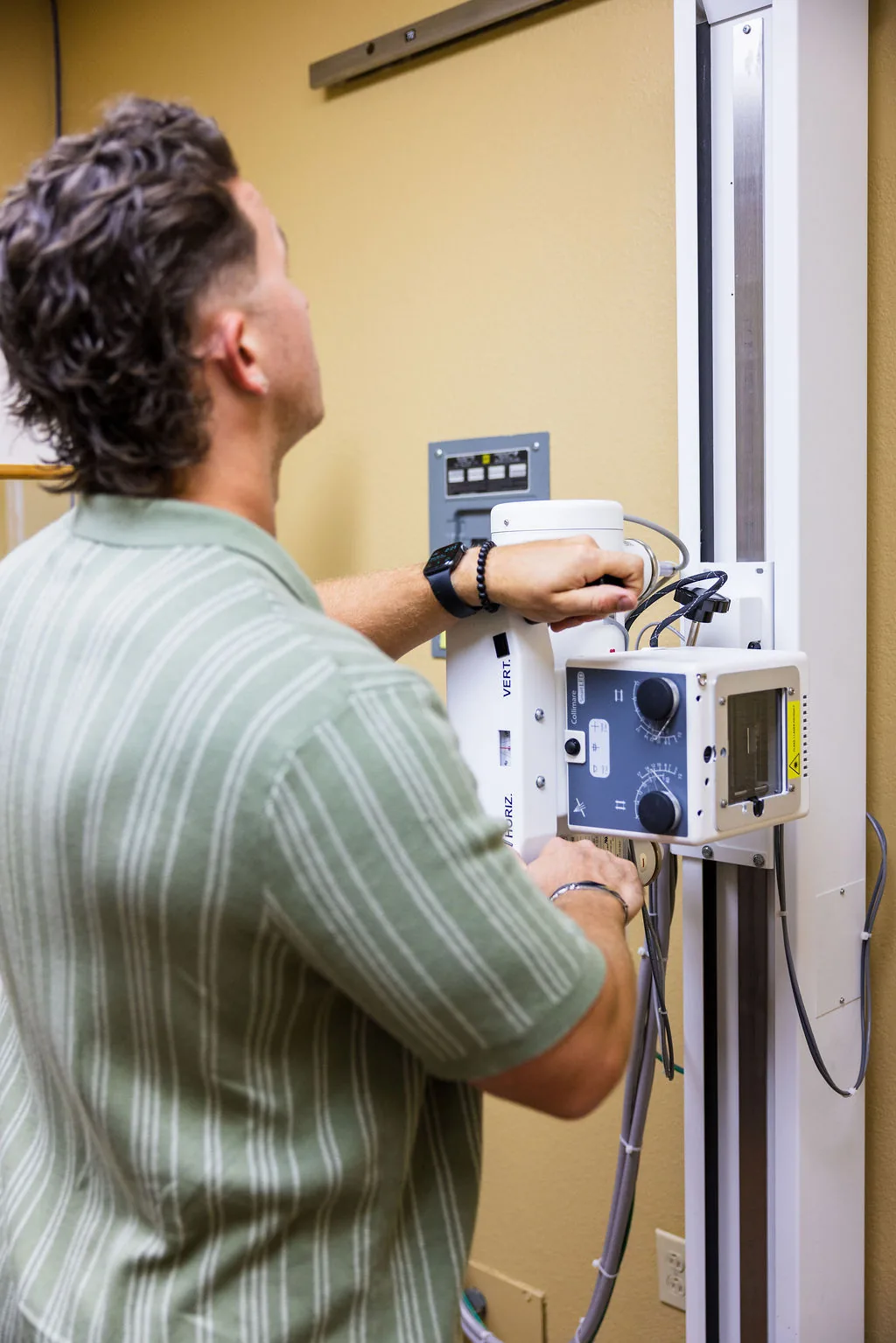
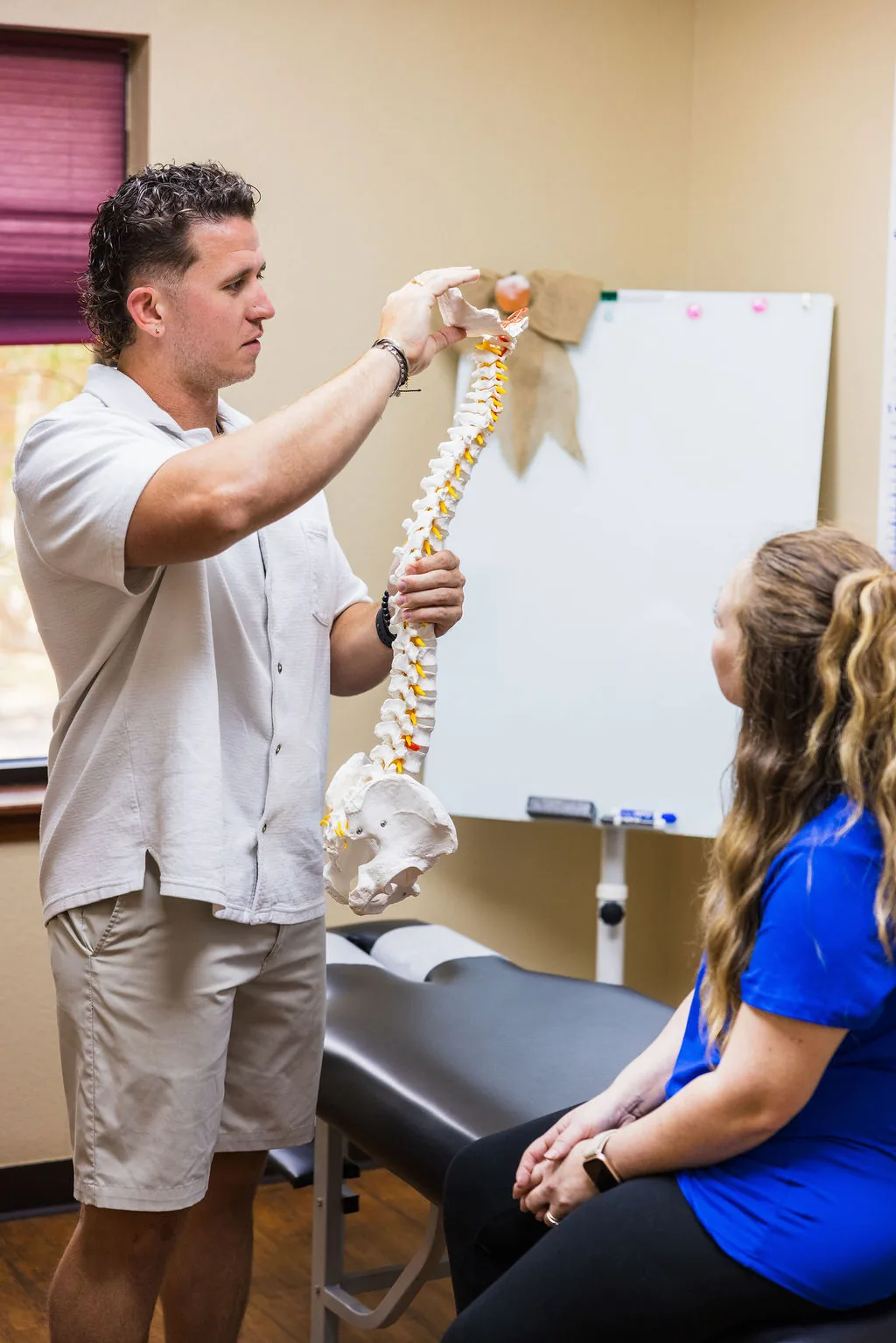
We look at how you move, not just how you stand. Dr. Hansen starts with your history: what your workday looks like, where you feel it, and what eases it. The exam checks neck and mid back range of motion, how the joints move, muscle tension and strength, with orthopedic and neurologic testing. Digital X-rays are taken in-house only when the findings call for them, and he shows you what he finds on a spine model or your images. Starting with the exam keeps care pointed at what’s actually driving your pain.
Care follows three steps. Prime uses guided breathing to help your body settle out of a guarded state. Facilitate is a gentle, specific adjustment to stiff areas of the neck and upper back. Integrate is what happens between visits, and for posture it carries most of the weight: exercises to build strength and endurance, changes to your workspace, and habits that break up long stretches of sitting.
A few changes that help most people:
Small adjustments to your desk and chair setup go a long way.
Some neck and upper back pain isn’t a posture problem at all. Arm weakness, trouble with balance or hand coordination, neck pain with fever, or chest pain with upper back pain need medical care first. If yours fits the everyday pattern, patients from Bryan, Navasota and nearby towns are welcome. Schedule your first appointment and we’ll take a look.
Not on its own, according to current research. Studies haven’t found that any single posture causes pain or that a “perfect” posture prevents it. What seems to matter more is holding one position for a long time, along with fitness, sleep, stress and how much you move. Posture can still be part of the picture for a sore neck or upper back, which is why we look at your whole day, not just how you stand.
How you hold your head can change, but chasing a perfect posture usually isn’t the most useful goal. Building strength and endurance in the neck and upper back, setting up your screens better, and moving more often tend to make the biggest difference in how you feel. Dr. Hansen gives home exercises based on your exam, and progress is judged by your symptoms and how you move.
We generally don’t recommend relying on one. A brace holds you in one position, and holding any position for long is part of the problem. Your muscles also don’t get stronger while a brace does the work. Better screen height, regular movement breaks and targeted exercises usually help more. If you like how one feels for short periods, talk with us about how it fits into your plan.
Slouching for a while isn’t harmful by itself. Research hasn’t found that slumped sitting causes back pain. The issue is staying slumped, or upright, for hours without moving. A comfortable slouch followed by getting up and stretching is fine. If slouching leaves you sore every day, that’s worth paying attention to.
Dr. Hansen checks how your neck and upper back move, where the joints are stiff, which muscles are tight or tired, and your strength. He also asks about your workday, screens, sleep and activity. X-rays are taken only when the findings call for them. The goal is to understand why you hurt, then build a plan around the way you actually live.
Yes, a lot. Texas A&M faculty, staff and graduate students in College Station often spend most of the day on a laptop, grading, writing or reading. That usually shows up as neck tension, an ache between the shoulder blades and headaches by afternoon. Raising the screen and getting up between classes or meetings helps, and an exam can show what else is involved.
Proudly serving College Station and Bryan, River of Life Chiropractic starts every visit with a real exam, not a guess. Ready to find out what’s actually going on?
Real feedback from the patients we’ve had the privilege to care for


 Trustindex verifies that the original source of the review is Google.
 Trustindex verifies that the original source of the review is Google.
 Trustindex verifies that the original source of the review is Google.
 Trustindex verifies that the original source of the review is Google.
 Trustindex verifies that the original source of the review is Google.
 Trustindex verifies that the original source of the review is Google.
 Trustindex verifies that the original source of the review is Google.
 Trustindex verifies that the original source of the review is Google.
 Trustindex verifies that the original source of the review is Google.
 Trustindex verifies that the original source of the review is Google.

College Station is home base, but patients regularly drive in from Bryan, Navasota, Caldwell, and Snook for care, most traveling somewhere between 30 and 45 minutes to get here. Within College Station itself, we see a lot of familiar faces from Pebble Creek, Indian Lakes, Southern Pointe, and the Castlegate and Castlerock communities.
Wherever you are driving in from, the visit looks the same: a real exam first, X-rays when they are actually needed, and a plan built around what your body is showing us, not a guess based on your zip code.
Contact us for expert chiropractic care in College Station, TX.
Monday: 9am – 1pm, & 3pm – 6pm
Tuesday: 3pm – 6pm
Wednesday: 9am – 1pm, & 3pm – 6pm
Thursday: 9am – 1pm, & 3pm – 6pm
Friday: 9am – 1pm, & 3pm – 6pm
Saturday: Closed
Sunday: Closed
