
Quick Summary: A herniated disc happens when the soft center of a spinal disc pushes through a tear in its tough outer ring. It can cause back pain, plus leg or arm symptoms when a nerve root gets irritated. In our College Station office, Dr. Hansen starts with a thorough exam to sort out what’s really going on.

Between each pair of bones in your spine sits a disc. Think of it as a small, rubbery cushion. Each one has a tough, flexible outer ring and a soft, jelly-like center, and together they work as shock absorbers every time you walk, bend, or lift. That description comes from the American Academy of Orthopaedic Surgeons.
A herniated disc happens when part of that soft center pushes out through a tear in the outer ring. That’s different from a bulging disc. A bulge is the outer layer pushing outward along a wider stretch of the disc’s edge, something that tends to happen as discs wear with age. A herniation is more localized. A crack lets some of the inner material stick out, and because it sticks out farther, it’s more likely to irritate a nearby nerve root and cause pain. Despite the nickname “slipped disc,” the whole disc doesn’t slip out of place.
A herniated disc can bother a nerve in two ways. The disc material can press on it, and according to the AAOS, it also releases chemical irritants that contribute to nerve inflammation. So the disc itself may not be what hurts most. The nerve is what’s yelling, which is why the pain can travel so far from where the disc actually is.
What it feels like depends on where the disc is and whether it’s pressing on a nerve. Common signs include:
People tend to describe it in plain terms. “I can’t bend down without the pain shooting down my leg.” “It hurts to sit for long periods.” “The pain wakes me up in the middle of the night.” Disc pain often starts gradually, and it can get worse with sitting or standing, at night, or with a cough or sneeze. Some days feel almost normal. Then one wrong move brings it right back.

Most herniated discs don’t come from one dramatic moment. According to Mayo Clinic, they typically develop over time as the natural aging process wears discs down. Then an ordinary movement becomes the last straw: lifting something heavy with your back instead of your legs, or twisting and turning while you lift.
Work plays a big role. Jobs that involve lifting, pulling, pushing, bending, or twisting raise the risk. We see this often in oilfield workers and others with physically demanding jobs from Bryan and Navasota, and their spines frequently show the wear that years of hard work leave behind. Desk work isn’t off the hook either. Prolonged sitting, carrying extra body weight, smoking, and an inactive lifestyle all show up on lists of risk factors, which is worth knowing for Texas A&M faculty who spend long days at a desk.
Age and family history play a part too. The AAOS notes that men between the ages of 20 and 50 are the most likely to have a herniated disc, and the AANS reports that a tendency toward disc herniation may run in families with several members affected. You can’t change either one, but both are worth knowing when we go through your history.
Sciatica isn’t a diagnosis by itself. It describes a pattern: sharp, often shooting pain that travels from the buttock down the back of one leg. A herniated disc in the lower back is one possible source of sciatica, because the displaced disc material can press on the nerve roots that feed into it. But a disc isn’t the only thing that can produce that pattern.
The same goes for back pain in general. Not every case of low back pain is a disc. Muscles, ligaments, and joints can all hurt in ways that feel alarming. And pain from an irritated SI joint can travel into the buttock and thigh in a pattern that looks a lot like nerve pain from a disc. Researchers have found that telling the two apart from symptoms alone is very difficult.
That overlap is why we don’t name a disc problem based on where it hurts. Calling pelvis-driven leg pain a disc problem, or treating an irritated nerve root as a simple muscle strain, sends the plan in the wrong direction. A careful exam keeps that from happening, and it tells us whether you belong in our office at all or need a different kind of care first.
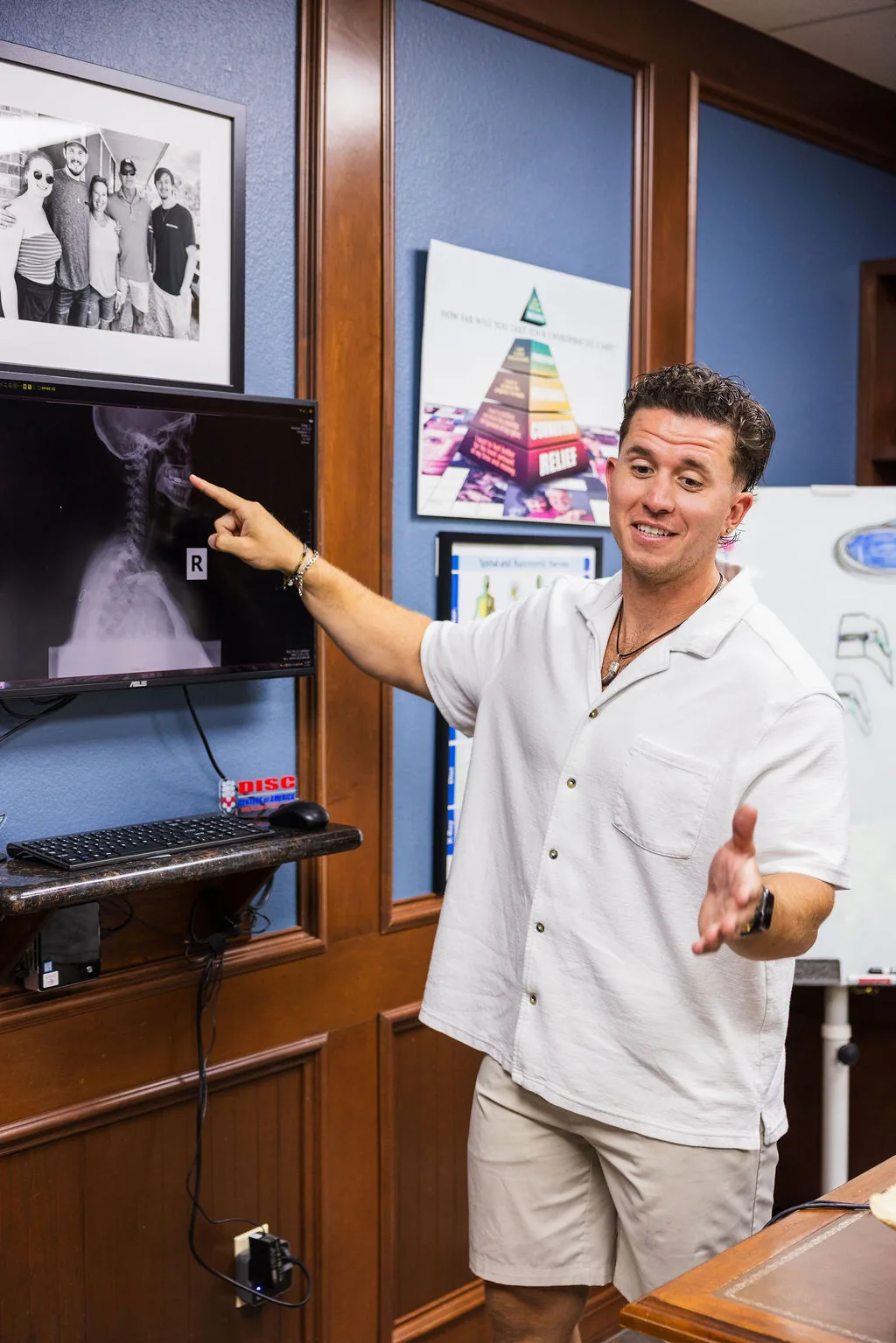
In our College Station office, every first visit starts with a detailed history and a hands-on physical exam. Dr. Hansen checks how your spine moves, tests strength, reflexes, and sensation in your legs or arms, and uses orthopedic tests to see what reproduces your pain. One example is the straight leg raise. MedlinePlus, from the National Library of Medicine, notes that a straight leg raise that brings back your leg pain usually points toward a disc in the lower back.
Digital X-rays are taken in-house only when the exam calls for them. They show bone and alignment well, but an X-ray alone can’t diagnose a herniated disc. When the exam shows significant nerve involvement, or symptoms aren’t improving as expected, we refer you to an imaging center for an MRI, which shows where a disc is pressing and which nerves are affected.
If Dr. Hansen believes he can help, he’ll tell you plainly and show you on a spine model or your X-rays. Our herniated disc and pinched nerve care follows three steps. Prime uses guided breathing to help your body settle out of a guarded state. Facilitate is a gentle, specific adjustment based on your exam, using Diversified technique or the Activator instrument. Integrate covers what happens between visits: movement, sleep, and home exercises. The AAOS reports that most people with a lower back herniation improve without surgery over a period of weeks to months.
Some situations need a surgeon or the ER, not an adjustment. Surgery is usually considered when symptoms persist after nonsurgical care, or when there’s progressive weakness or trouble walking. Get emergency care right away if you notice:
The first two can be signs of cauda equina syndrome, a rare but true medical emergency. We would never adjust with those signs present. If none of them apply and you’re ready for real answers, schedule your first appointment and we’ll start with a thorough exam.
Get checked soon if numbness or tingling keeps spreading or shows up with weakness, like a foot that catches on steps or a hand that starts dropping things. A nerve under pressure can affect the muscles it supplies, so weakness is the sign not to wait on. Tingling that comes and goes with certain positions is less urgent, but it still deserves an exam. Numbness in the groin or inner thighs, or new bladder or bowel trouble, means the ER right away.
Yes. A herniated disc in the neck can irritate a nerve root that runs into the arm. That can mean pain when you move your neck, plus pain that spreads into the upper arm, forearm, and fingers, with numbness or tingling in the shoulder, elbow, or hand. Some people notice weakness in the arm as well. We test strength, reflexes, and sensation in both arms to see which nerve may be involved and how much.
Not always. A careful history and physical exam are the first step, and they often tell us a lot about whether a nerve root is involved. An MRI is the test that actually shows where a disc is pressing, and X-rays alone can’t diagnose a herniation. If your exam shows significant nerve signs, or your symptoms aren’t improving as expected, Dr. Hansen will refer you to an imaging center for an MRI.
Most people with a herniated disc don’t. The American Academy of Orthopaedic Surgeons reports that only a small percentage of people with a lower back herniation need surgery, and most improve with nonsurgical care over several weeks to a few months. Surgery is usually considered when symptoms persist despite conservative care, or with worsening weakness, trouble walking, or loss of bladder or bowel control. If you reach that point, we’ll help you connect with a surgeon.
Often, yes, but only after an exam rules out red flags. If there are none, Dr. Hansen uses gentle, specific, controlled adjustments based on your findings, and he may use the Activator instrument instead of a manual adjustment. The pop is not the goal. If there are signs of serious nerve compression, such as bladder changes or worsening weakness, we won’t adjust. We’ll send you for urgent medical care instead.
Yes, often. Many of our patients do oilfield work and other physically demanding jobs, and they come to us from all over the area. Jobs that involve lifting, pulling, pushing, bending, and twisting raise the risk of a herniated disc, and years of that work tend to show up as wear on the spine. We’ll talk through what your workday looks like so your home exercises and care plan fit the job you actually do.
Proudly serving College Station and Bryan, River of Life Chiropractic starts every visit with a real exam, not a guess. Ready to find out what’s actually going on?
Real feedback from the patients we’ve had the privilege to care for
Posted on Google
 Mark Knox2 days ago
Trustindex verifies that the original source of the review is Google.
I will most definitely come to River of life chiropractic the next time I need an adjustment!Posted on Google Courtney Allen25 days agoGreat service! Dr. Hansen really listens and works with you to achieve your goals. The practice helps me to be consistent while also providing flexibility. Amanda is always so helpful and friendly - a true pleasure to speak with!Posted on Google
 Doris Vigil33 days agoI start going for help with the pain in knees and lower back. I had a hard time climbing stairs not sure if it was my knees or back that was to problem. Coming to River of life has helped me move around, right now I don't have knee pain. Funny I didn't even realize I was not hurting climbing up and down a ladder until today. I am looking forward to be pain free. Thank you for your help and very flexible on my hours. Well worth the time and money. Thank you and your team.Posted on Google
 Anna Fildes45 days agoI've had very positive experiences with Dr. Levi and would recommend him to others. What stands out most is his honesty and dedication to helping people achieve better health and wellness. The faith-based foundation of the practice creates a welcoming and encouraging environment. Amanda is also fantastic, always friendly, responsive, and on top of the administrative details. RLC is a great place to receive care.Posted on Google
 Craig Becerra54 days agoI recently experienced a sciatic nerve issue that caused significant discomfort and made everyday activities extremely difficult. Even simple tasks like putting on my socks, shoes, or pants in the morning would take me at least 20 minutes because of the pain and limited mobility. I came here for treatment, and within a month, I was amazed at how much better I felt. The pain that had been interfering with my daily routine was gone, and I was able to get back to my normal activities. I’m very grateful for the care and professionalism I received. I highly recommend this establishment to anyone experiencing similar pain or discomfort. They made a significant difference in my quality of life!Posted on Google
 Christian Fierro60 days agoDr. Hansen is by far the best chiropractor in the College Station/Bryan area. He does an amazing job and is a super nice guy. I highly recommend him.Posted on Google
 Jim Baca60 days agoI’ve had a great experience with Dr. Levi at River of Life Chiropractic. He’s incredibly personable, easy to talk to, and you can tell right away that he genuinely cares about the people he’s helping. What I appreciate most is that he takes the time to listen, explain what he’s doing, and make sure you’re comfortable throughout the process. You never feel rushed or like just another appointment on the schedule.Posted on Google
 Melissa Garza67 days agoDr. Hansen actually took X-rays of my spine and went over them with me in detail while explaining my care plan. It was such a different experience from other chiropractors I’ve seen, where treatment began without first getting a clear picture of what was actually going on. Having now experienced both approaches, the difference is astounding. I really appreciate the thoroughness and thought that went into understanding my condition before beginning treatment.Posted on Google
 Kelly Chadwick68 days agoI came in to see Dr. Hansen about 3 months ago. I was having pretty severe neck pain daily. I was struggling with extreme migraines at least 2-3 days a week. After the new patient exam he found underlying issues that were causing the pain and headaches. He made a plan for me and I’m so happy to say that my daily neck pain is gone, I’ve had one migraine since I started. On re exam day I was literally in tears because I had no idea how much those issues were affecting my daily functioning. My overall quality of life has been improved. I am so grateful for the Dr. and this practice! They genuinely care about their patients and take their time to listen and find solutions. 10/10 highly recommend⭐️⭐️⭐️⭐️⭐️Posted on Google
 Sara Bassetti68 days agoI first started seeing Dr. Hansen because I hurt my lower back at the gym. He got it moving and feeling better within the first visit and helped my neck issues as well. I have much more range of motion in my neck and back and no more pain. He’s personable, friendly and professional. I highly recommend him to everyone. For me chiropractic care has been essential to my wellness routine.Verified by TrustindexTrustindex verified badge is the Universal Symbol of Trust. Only the greatest companies can get the verified badge who has a review score above 4.5, based on customer reviews over the past 12 months. Read more

College Station is home base, but patients regularly drive in from Bryan, Navasota, Caldwell, and Snook for care, most traveling somewhere between 30 and 45 minutes to get here. Within College Station itself, we see a lot of familiar faces from Pebble Creek, Indian Lakes, Southern Pointe, and the Castlegate and Castlerock communities.
Wherever you are driving in from, the visit looks the same: a real exam first, X-rays when they are actually needed, and a plan built around what your body is showing us, not a guess based on your zip code.
Contact us for expert chiropractic care in College Station, TX.
Monday: 9am – 1pm, & 3pm – 6pm
Tuesday: 3pm – 6pm
Wednesday: 9am – 1pm, & 3pm – 6pm
Thursday: 9am – 1pm, & 3pm – 6pm
Friday: 9am – 1pm, & 3pm – 6pm
Saturday: Closed
Sunday: Closed
