
Why Does My Shoulder Hurt When I Raise My Arm?
You reach for a high shelf, pull on a shirt or lift your arm to wave, and the top of your shoulder pinches. Lower the arm and it eases. Here is what usually causes that pain, how to tell whether it’s coming from the shoulder or the neck, and what helps.
The Short Answer
Shoulder pain when you raise your arm usually comes from the rotator cuff tendons or the bursa above them getting squeezed in the narrow space at the top of the shoulder. This is often called impingement, and it tends to hurt most from about shoulder height to overhead. A stiff upper back and a shoulder blade that doesn’t move well make that space smaller.
Most cases improve with rest from the painful movement, ice, and exercises that restore shoulder blade control. Pain with weakness, a pop after an injury, or symptoms that keep getting worse should be checked.

Why Raising Your Arm Pinches the Shoulder
The rotator cuff is a group of four muscles and tendons that hold the ball of your arm bone in its socket. Their tendons, along with a small fluid-filled cushion called the bursa, pass under a bony shelf at the top of the shoulder. As your arm rises, that space naturally gets smaller.
When the tendons are irritated or the space is tighter than usual, lifting the arm pinches them. Mayo Clinic on shoulder pain lists rotator cuff injury, impingement and tendinitis among the common causes, and notes that pain from the joint itself usually gets worse when you move your arm.
A few things make that pinch more likely:
- Repeated overhead work, like painting, stocking shelves or lifting kids into car seats
- Sports with overhead motion, like softball, swimming, volleyball and pressing in the gym
- A rounded upper back from long hours at a desk
- A sudden jump in activity, like the first big project of the season
Is It Your Shoulder or Your Neck?
Not all shoulder pain starts in the shoulder. Mayo Clinic calls this referred pain and lists nerve problems in the neck among the causes. The key clue it gives: referred pain usually doesn’t get worse when you move your shoulder.
- Points to the shoulder: pain that starts or sharpens partway through lifting your arm and eases when you lower it
- Points to the neck: pain that stays about the same no matter how you move your arm, or that turning your head brings on
- Points to a nerve: numbness or tingling running into the arm or hand, which can come from a pinched nerve in the neck
These clues help, but they can overlap. Plenty of people have a sore shoulder and a stiff neck at the same time.
What Helps at Home
For minor shoulder pain, Mayo Clinic suggests a few simple steps:
- Rest from the painful movement. Avoid the reaching or lifting that sets it off, but keep the arm moving gently below that range so it doesn’t stiffen.
- Use ice. An ice pack for 15 to 20 minutes a few times a day can calm an irritated shoulder.
- Try a topical pain gel first. Mayo Clinic suggests topical options before oral pain relievers.
A few habits help too. Sit up tall before you reach overhead, keep things you use often between waist and shoulder height, and sleep on the other side or on your back with a pillow under the sore arm.
Why the Shoulder Blade Matters
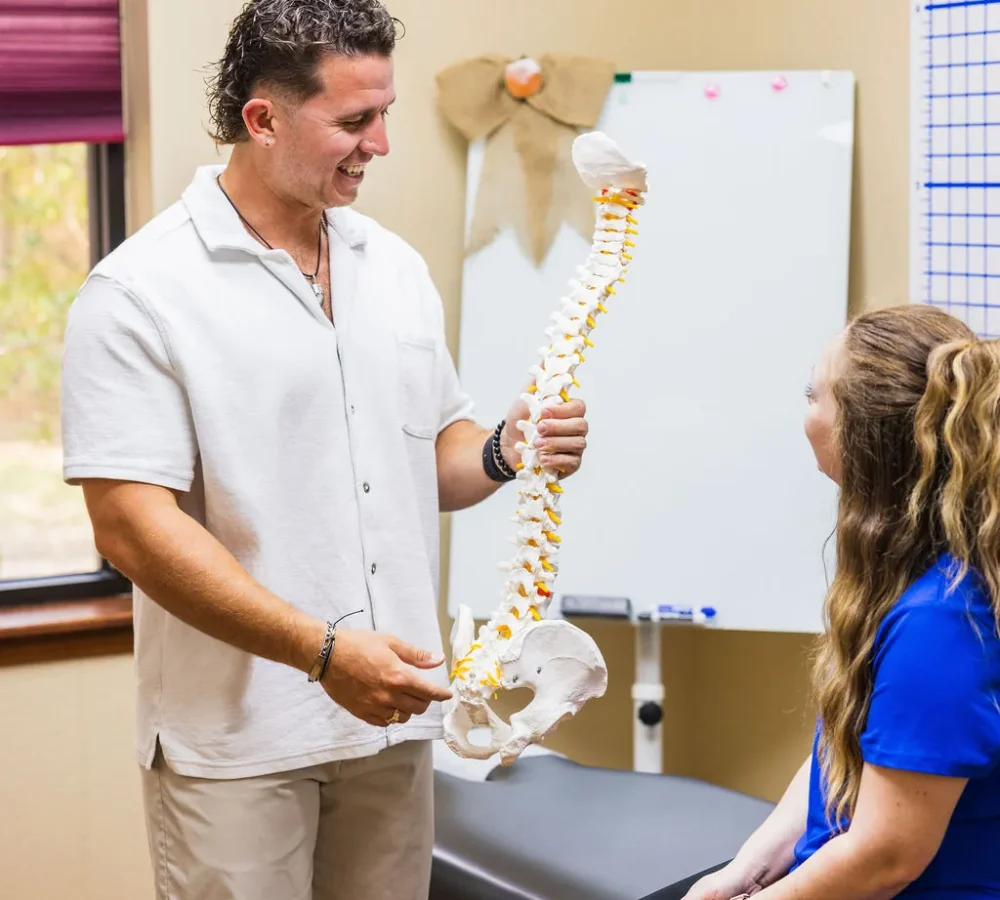
Your arm can only rise smoothly if your shoulder blade rotates and tilts with it. When the muscles that control the shoulder blade are weak or tired, or your upper back is stiff and rounded, the shoulder blade lags behind and the space at the top of the shoulder shrinks. Try it: slump and raise your arm, then sit tall and raise it again. Most people feel the difference right away.
That’s why rounded shoulders and forward head posture show up so often with this kind of pain, and why shoulder blade strengthening exercises are usually part of lasting relief.
What a Visit Looks Like at River of Life
Every first visit starts with your history: which movements hurt, how you sleep, your work and sports, and any numbness or tingling. Then comes a hands-on exam of the shoulder, neck and upper back with range of motion, orthopedic and neurologic testing. Checking all three is why the exam comes first. If care is a good fit, it follows three steps: Prime, guided breathing to help guarded muscles settle; Facilitate, gentle adjustments to the neck, upper back and ribs plus soft tissue work; and Integrate, shoulder blade exercises and habit changes. If you’re dealing with ongoing shoulder pain, that’s where we start.
When Shoulder Pain Needs Medical Care
Most shoulder pain when lifting the arm is muscular, but Mayo Clinic’s guidance lists signs that need urgent attention.
Get medical care right away for:
- Shoulder pain with trouble breathing, chest tightness or sweating, which can signal a heart attack (call 911)
- A shoulder that looks deformed after a fall
- Being unable to move your arm away from your body
- Intense pain or sudden swelling
- Swelling, redness and warmth around the joint, or pain that keeps getting worse
Shoulder still pinching when you reach?
We’re glad to answer questions before you book. See what to expect at your first visit.
Sources
This article is for general education and is not medical advice. For questions about your own health, talk with your doctor or another qualified healthcare provider.
From the team at River of Life Chiropractic, 4519 Mills Park Cir Ste 300, College Station, TX 77845.
About the Author

Dr. Levi Hansen, DC
Founder of River of Life Chiropractic in College Station, TX
Webster Certified (ICPA)B.S. Neuroscience, WSU
Raised in Kenai, Alaska, Dr. Hansen played football at Washington State, earned a B.S. in Neuroscience, then his Doctor of Chiropractic from Parker University. Every visit starts with a real exam, followed by his three-step Prime, Facilitate, Integrate process.
- Every visit starts with a physical exam
- Nervous system scans and digital X-rays
- Care for families, athletes and expecting moms
- 4519 Mills Park Cir Ste 300, College Station, TX
Prefer to call? (979) 383-2105
What College Station Is Saying
Real feedback from the patients we’ve had the privilege to care for


 Trustindex verifies that the original source of the review is Google.
 Trustindex verifies that the original source of the review is Google.
 Trustindex verifies that the original source of the review is Google.
 Trustindex verifies that the original source of the review is Google.
 Trustindex verifies that the original source of the review is Google.
 Trustindex verifies that the original source of the review is Google.
 Trustindex verifies that the original source of the review is Google.
 Trustindex verifies that the original source of the review is Google.
 Trustindex verifies that the original source of the review is Google.
 Trustindex verifies that the original source of the review is Google.
VISIT OUR OFFICE
Contact us for expert chiropractic care in College Station, TX.
PHONE
HOURS
Monday: 9am – 1pm, & 3pm – 6pm
Tuesday: 3pm – 6pm
Wednesday: 9am – 1pm, & 3pm – 6pm
Thursday: 9am – 1pm, & 3pm – 6pm
Friday: 9am – 1pm, & 3pm – 6pm
Saturday: Closed
Sunday: Closed