
What “Degenerative” Means on Your X-ray or MRI Report
Few words on a medical report cause more worry than “degenerative.” It sounds like your spine is falling apart. In most cases it describes normal changes that show up in people with and without pain. Here is what the common terms mean and what actually matters.
The Short Answer
“Degenerative” means the discs and joints of your spine show normal age-related wear, like drying out, thinning or small bone spurs. These changes are very common in people with no pain at all, and they become more common with every decade. On their own, they don’t tell you why you hurt or predict how you’ll do.
What matters more is how you feel, how your spine moves, and whether there are signs of an irritated nerve.
How Common Degenerative Changes Are
A large review in the American Journal of Neuroradiology looked at spine imaging in people with no back pain. Disc degeneration showed up in 37% of 20-year-olds and 96% of 80-year-olds. Disc bulges went from 30% at age 20 to 84% at age 80. The authors concluded these findings are common in people without symptoms and increase with age.
Cleveland Clinic on degenerative disk disease puts it simply: almost everyone has some disc degeneration after 40, even without symptoms, and the condition isn’t really a disease.
Common Terms on Your Report
A few phrases show up again and again:
- Disc degeneration or desiccation: the disc has lost some water and height. This is the core of degenerative disc disease.
- Disc bulge: the disc extends a little beyond its normal edge, usually evenly. Very common and often painless.
- Herniation or protrusion: part of the inner disc pushes out further, sometimes near a nerve. The difference between a bulge and a herniation is worth understanding before you worry.
- Osteophytes or bone spurs: small bony edges that form as joints age.
- Facet arthropathy: wear in the small joints at the back of the spine.
- Foraminal narrowing: less space where a nerve exits the spine. This matters more when you also have matching arm or leg symptoms.
When the Findings Do Matter
Imaging becomes more meaningful when it matches what’s happening in your body. If a disc is pressing on a nerve, the AANS on herniated discs describes pain, burning, tingling or numbness that travels from the buttock into the leg, or from the neck into the arm. That leg pattern, often called sciatica from a nerve root, is when a finding like foraminal narrowing or a herniation becomes important.
Findings also matter when there are red flags, like new weakness, numbness in the groin, or trouble controlling your bladder or bowels. Those need medical care right away.
What to Look for in a Provider
If you’re dealing with pain and a report full of unfamiliar terms, a few things are worth asking about before you book.
- Someone who explains your images. You should leave understanding what the report says and what it doesn’t.
- An exam that goes beyond the images. Movement, strength, reflexes and sensation tell more about why you hurt.
- Honesty about scope. Severe degeneration or worsening nerve problems should be referred to a specialist.
- Clear communication. You should understand what care involves and what it costs before you start.
Questions to Ask About Your Report
Bring these to whoever reviews your images with you:
- Do these findings match where I actually hurt?
- Is anything pressing on a nerve, and do my symptoms fit that?
- Are any of these findings unusual for my age?
- What would change if I did nothing for now?
- What can I do to help my back move and feel better?
What a Visit Looks Like at River of Life
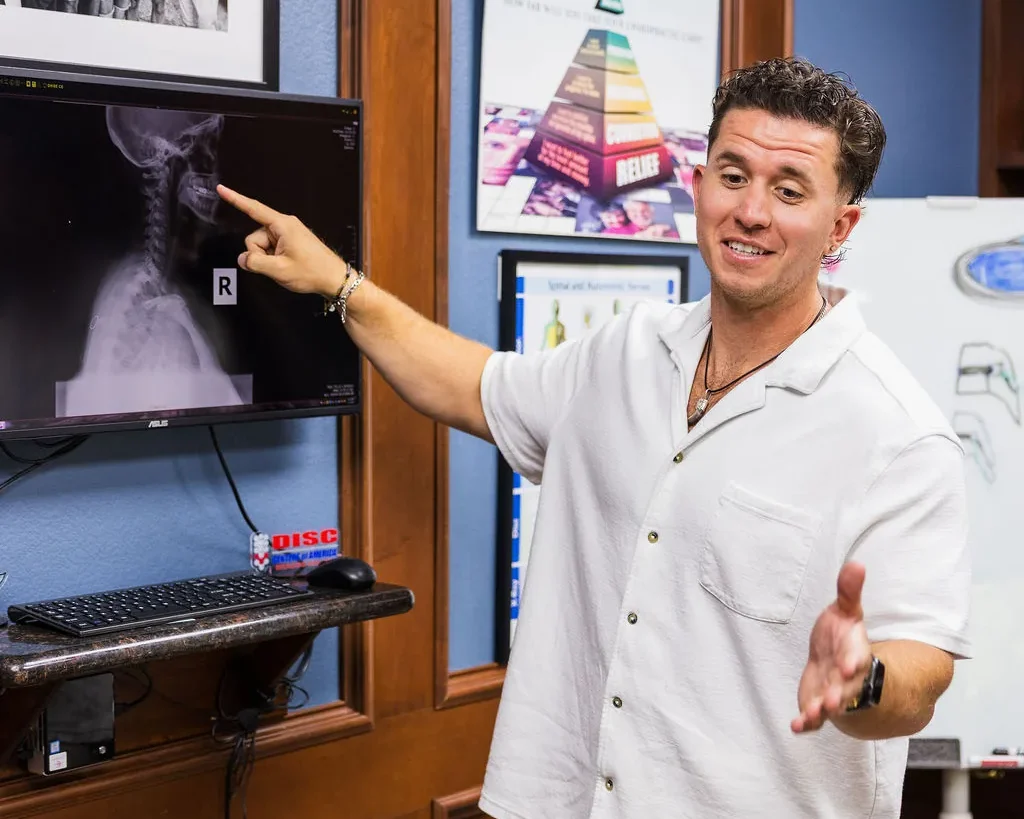
Dr. Hansen goes over any X-rays or MRI you already have in plain language, then compares them with what he finds on a hands-on exam: range of motion, orthopedic and neurologic testing, and palpation of the spine. Images are one piece of the picture, which is why the hands-on exam matters. If care is a good fit, it follows three steps: Prime, guided breathing; Facilitate, a gentle, specific adjustment; and Integrate, home exercises and movement. If your degeneration is severe or a nerve is getting worse, he’ll refer you to a specialist.
When to Get Medical Care Right Away
Most degenerative findings are not urgent. These symptoms are, and they need a physician or the ER before anything else.
Get medical care right away for:
- Numbness in the groin or inner thighs
- New trouble controlling your bladder or bowels
- Leg or arm weakness that keeps getting worse
- Back pain with fever or weight loss you can’t explain
- Pain after a fall or crash
Confused by your imaging report?
Bring it to your first visit and we’ll go over it in plain language. See what to expect before you come in.
Sources
This article is for general education and is not medical advice. For questions about your own health, talk with your doctor or another qualified healthcare provider.
From the team at River of Life Chiropractic, 4519 Mills Park Cir Ste 300, College Station, TX 77845.
About the Author

Dr. Levi Hansen, DC
Founder of River of Life Chiropractic in College Station, TX
Webster Certified (ICPA)B.S. Neuroscience, WSU
Raised in Kenai, Alaska, Dr. Hansen played football at Washington State, earned a B.S. in Neuroscience, then his Doctor of Chiropractic from Parker University. Every visit starts with a real exam, followed by his three-step Prime, Facilitate, Integrate process.
- Every visit starts with a physical exam
- Nervous system scans and digital X-rays
- Care for families, athletes and expecting moms
- 4519 Mills Park Cir Ste 300, College Station, TX
Prefer to call? (979) 383-2105
What College Station Is Saying
Real feedback from the patients we’ve had the privilege to care for


 Trustindex verifies that the original source of the review is Google.
 Trustindex verifies that the original source of the review is Google.
 Trustindex verifies that the original source of the review is Google.
 Trustindex verifies that the original source of the review is Google.
 Trustindex verifies that the original source of the review is Google.
 Trustindex verifies that the original source of the review is Google.
 Trustindex verifies that the original source of the review is Google.
 Trustindex verifies that the original source of the review is Google.
 Trustindex verifies that the original source of the review is Google.
 Trustindex verifies that the original source of the review is Google.
VISIT OUR OFFICE
Contact us for expert chiropractic care in College Station, TX.
PHONE
HOURS
Monday: 9am – 1pm, & 3pm – 6pm
Tuesday: 3pm – 6pm
Wednesday: 9am – 1pm, & 3pm – 6pm
Thursday: 9am – 1pm, & 3pm – 6pm
Friday: 9am – 1pm, & 3pm – 6pm
Saturday: Closed
Sunday: Closed