
Quick Summary: Degenerative disc disease is not really a disease. It is the normal wearing and drying out of the spinal discs with age, and almost everyone has some by 40. Many people with it have no pain at all. When it does hurt, it often shows up as back or neck pain that comes and goes and flares with sitting, bending or lifting. Dr. Hansen’s exam looks at how your spine moves and functions, not just what an image shows.
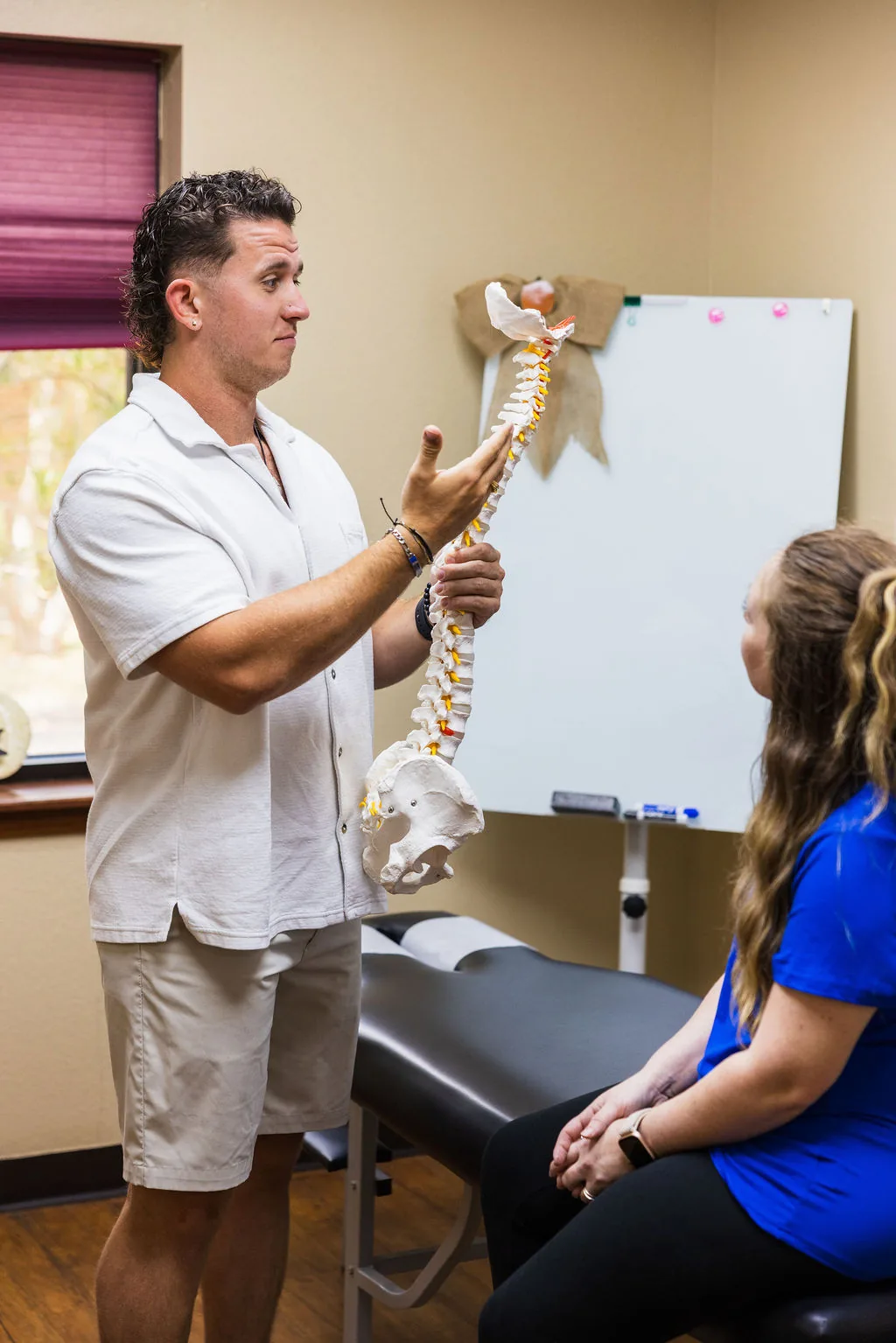
Degenerative disc disease is the gradual wearing down of the discs that cushion the bones of your spine. Despite the name, Cleveland Clinic notes it isn’t actually a disease but a condition that comes with aging, and that almost everyone has some disc degeneration after age 40, even without symptoms. Each disc has a tough outer ring and a softer, gel-like center, a bit like a jelly donut. As discs lose water, they get thinner and absorb shock less well.
When it does cause symptoms, Cleveland Clinic describes:
Cleveland Clinic lists age over 40, past injuries, smoking, extra body weight and physically demanding work among the risk factors.
Most of it, about 90% according to Cleveland Clinic, shows up in the lowest part of the low back, though it can affect the neck too. Over time, worn discs can contribute to other problems, including a disc that herniates and presses on a nerve, or narrowing of the spaces the nerves pass through.
Many of the people we see in our College Station chiropractic practice, from Pebble Creek to the Brazos Valley’s smaller towns, come in after hearing the word “degenerative” on an X-ray or MRI report and assuming their back is worn out. That word usually sounds a lot worse than it is.
Disc changes on imaging are extremely common in people with no pain at all. A large review in the American Journal of Neuroradiology looked at spine imaging in people without back pain and found disc degeneration in 37% of 20-year-olds, rising to 96% of 80-year-olds. Disc bulges followed the same pattern, from 30% at age 20 to 84% at age 80. The authors concluded that signs of degeneration are common in people without symptoms and increase with age.
That doesn’t mean imaging is useless. It shows structure, alignment and disc height, and it matters when something serious is suspected. It just can’t tell you on its own why you hurt. Two people with the same images can feel completely different, and plenty of people with “bad” images feel fine. The terms that worry people most also mean different things, and the difference between a bulging and herniated disc matters more than the word degenerative.
What usually matters more is how your spine is moving and handling load: stiff joints above or below a worn disc, weak or guarded muscles, long hours of sitting, and how active you are. Those are things that can change, even when the disc itself won’t look different on the next image. When pain travels down the leg, it may involve an irritated nerve, which is the classic pattern of sciatica from a disc.
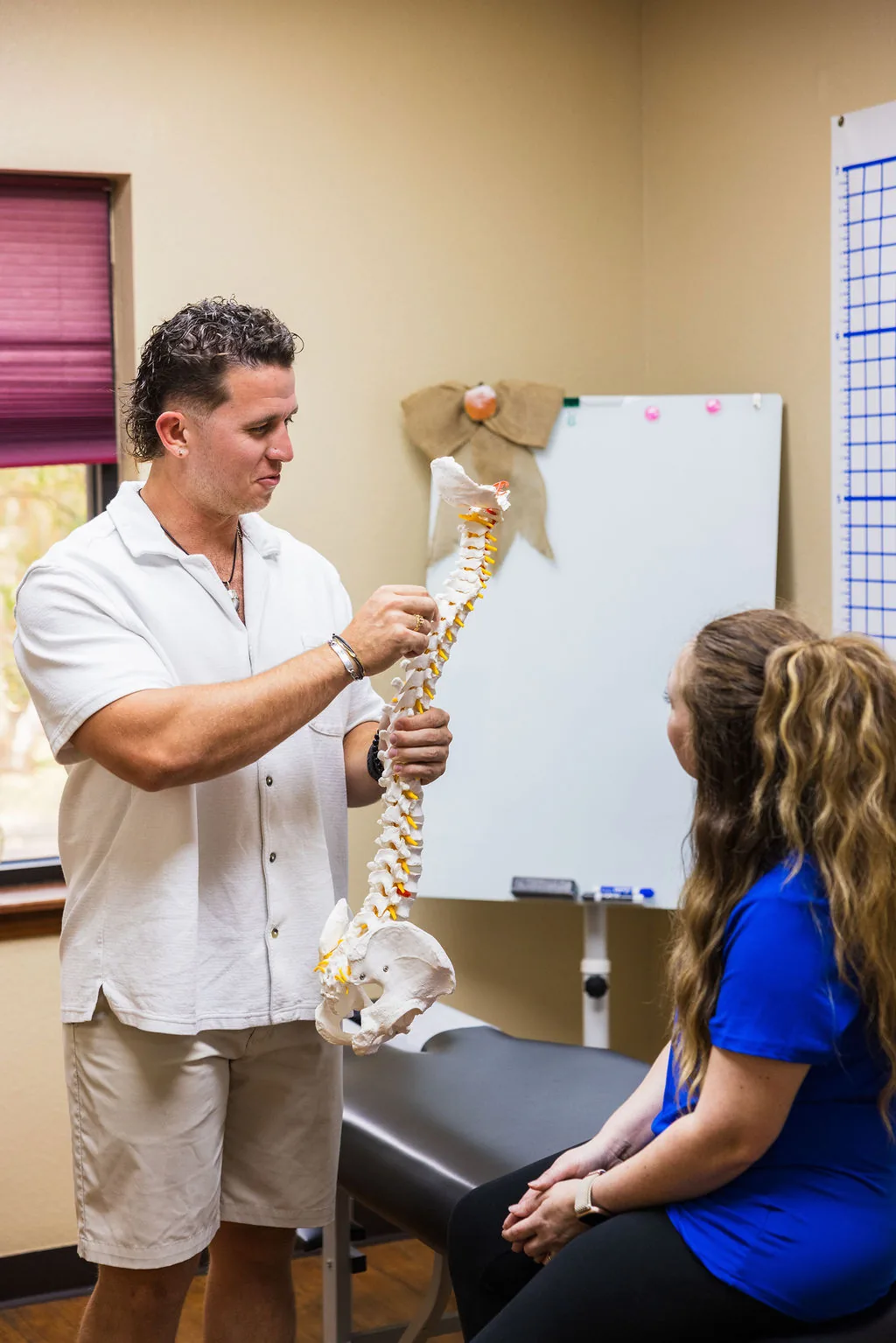
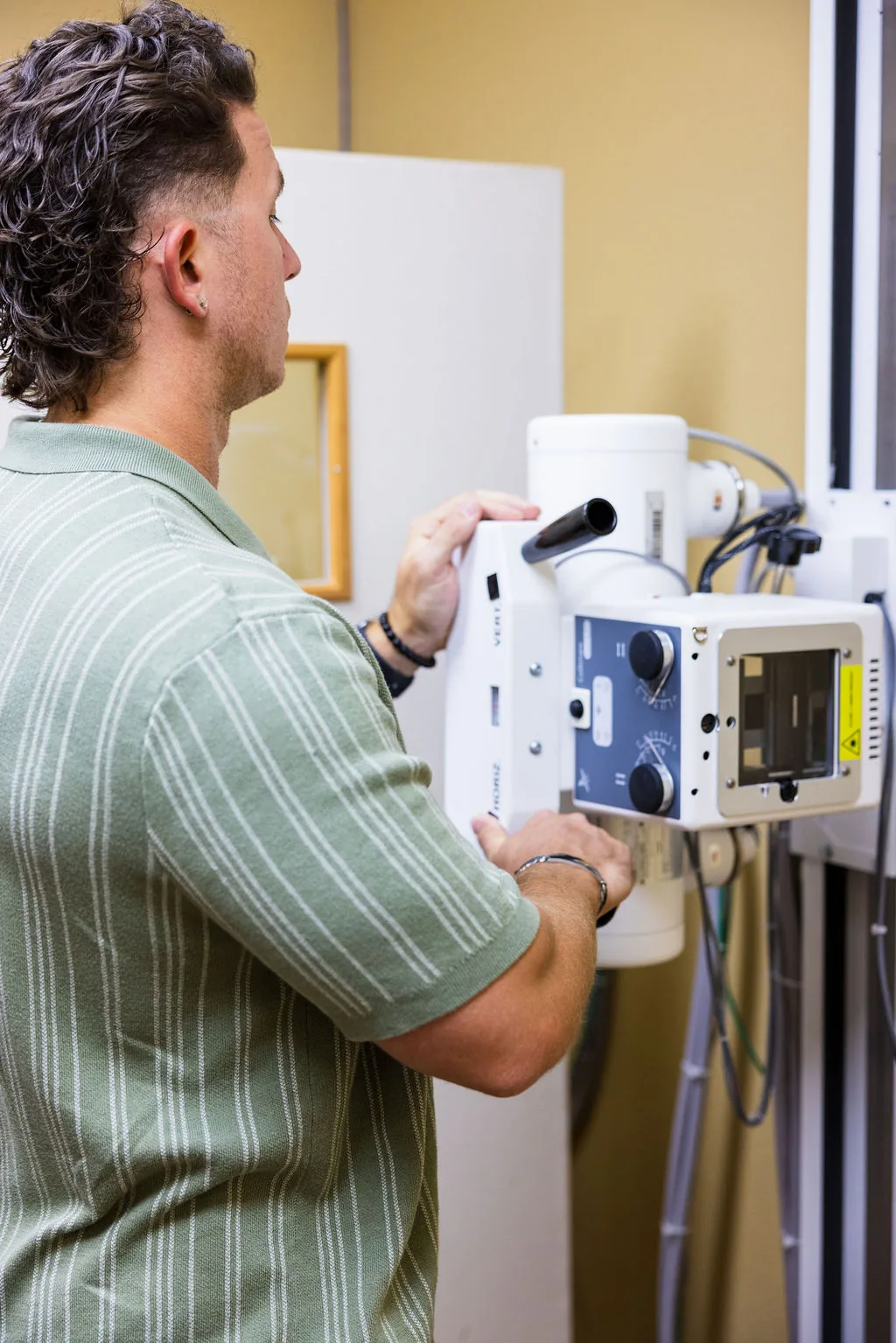
We look at function, not just the image. Dr. Hansen starts with your history: where it hurts, what makes it better or worse, and whether pain, numbness or weakness travels into your legs or arms. Then comes a hands-on exam with range of motion, orthopedic and neurologic testing, and palpation of the spine. Digital X-rays are taken in-house when the findings call for them, and if you already have an MRI, he’ll go over it with you in plain language. Comparing your symptoms with your images is why the exam always comes first.
When care is a good fit, it follows three steps. Prime uses guided breathing to help your body settle out of a guarded state. Facilitate is a gentle, specific adjustment to the stiff areas around the worn disc, with lower-force options like Activator when they fit better. Integrate covers home exercises, movement and sitting habits. Cleveland Clinic lists strengthening and stretching among the first-line treatments, and building strength around the spine is a big part of the plan here too.
Severe degeneration isn’t something we try to manage alone. If the exam or imaging shows advanced changes, nerve compression that’s getting worse, or a problem outside our scope, Dr. Hansen refers you to the right specialist. Get medical care right away for:
If yours fits the everyday pattern, patients in Bryan, Navasota and Caldwell are welcome. Schedule your first appointment and we’ll take a careful look.
Usually not. It’s a normal part of aging, and almost everyone has some disc degeneration after 40, often with no pain at all. When it does cause symptoms, most people do well with conservative care like exercise, movement and hands-on care. It becomes more serious when it leads to nerve compression with worsening weakness or other red flags, which need a specialist.
The disc changes themselves don’t go away, but pain and function often improve a lot. What changes is how well your spine moves, how strong the surrounding muscles are, and how your body handles daily load. Many people with clear degeneration on imaging live without pain, so the image isn’t the whole story.
For most people, yes, once a proper exam has been done. Adjustments are gentle and specific to the stiff areas, and lower-force options like Activator are available. Dr. Hansen checks for red flags and severe changes first, and if your degeneration is advanced or a nerve is getting worse, he’ll refer you instead of adjusting.
Disc pain usually stays near the spine as an ache in the low back or neck. Sciatica travels down the leg, often past the knee, because a nerve root near a worn or herniated disc is irritated. Both can come from the same disc. Pain, numbness or tingling that runs down a leg or arm deserves an exam, and weakness that keeps getting worse needs prompt attention.
Not always. Many cases can be evaluated with a careful history, a hands-on exam and X-rays when needed. An MRI is more useful when there’s significant nerve involvement, weakness, or symptoms that aren’t improving with care. If one is needed, Dr. Hansen refers you to an imaging center and goes over the results with you.
Yes. We see adults of all ages from College Station and across the Brazos Valley, including many over 40 who’ve been told they have degenerative discs. Texas A&M faculty, retirees and people with physically demanding jobs all fit that picture. Your first visit includes a full history and exam, so we can explain what your images mean and what we can realistically help with.
Proudly serving College Station and Bryan, River of Life Chiropractic starts every visit with a real exam, not a guess. Ready to find out what’s actually going on?
Real feedback from the patients we’ve had the privilege to care for


 Trustindex verifies that the original source of the review is Google.
 Trustindex verifies that the original source of the review is Google.
 Trustindex verifies that the original source of the review is Google.
 Trustindex verifies that the original source of the review is Google.
 Trustindex verifies that the original source of the review is Google.
 Trustindex verifies that the original source of the review is Google.
 Trustindex verifies that the original source of the review is Google.
 Trustindex verifies that the original source of the review is Google.
 Trustindex verifies that the original source of the review is Google.
 Trustindex verifies that the original source of the review is Google.

College Station is home base, but patients regularly drive in from Bryan, Navasota, Caldwell, and Snook for care, most traveling somewhere between 30 and 45 minutes to get here. Within College Station itself, we see a lot of familiar faces from Pebble Creek, Indian Lakes, Southern Pointe, and the Castlegate and Castlerock communities.
Wherever you are driving in from, the visit looks the same: a real exam first, X-rays when they are actually needed, and a plan built around what your body is showing us, not a guess based on your zip code.
Contact us for expert chiropractic care in College Station, TX.
Monday: 9am – 1pm, & 3pm – 6pm
Tuesday: 3pm – 6pm
Wednesday: 9am – 1pm, & 3pm – 6pm
Thursday: 9am – 1pm, & 3pm – 6pm
Friday: 9am – 1pm, & 3pm – 6pm
Saturday: Closed
Sunday: Closed
